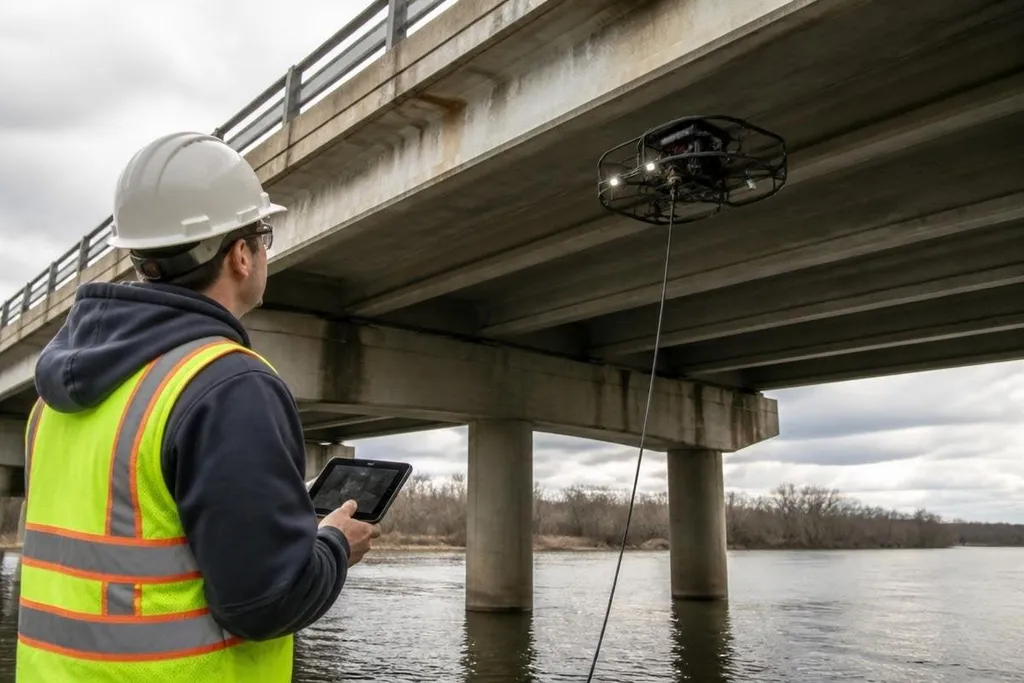
A bridge robot may fly under a deck, crawl along a steel beam, or send sound through concrete. Its job is to collect useful evidence from places that are hard, risky, or slow for people to reach.
The inspection still belongs to trained bridge engineers. Robots change how inspectors get information, not who makes the safety decision.
Quick read
- Drones use cameras and LiDAR to check surfaces, joints, cables, and areas below the deck.
- Crawlers keep contact with steel or concrete while sensors look for cracks, corrosion, or changes in shape.
- Human inspectors review robot data and decide which defects need closer checks or repair.
What the robot sees
A drone usually starts with visual data. Its RGB camera records the bridge surface, while LiDAR measures distance with laser pulses and builds a 3D view of beams, piers, cables, and the space around them.
That view helps an inspection team compare the bridge with earlier records. A camera may show rust around a connection plate. LiDAR can show that a beam or deck section has changed position or shape. The two data types answer different questions, so using both can give inspectors a better starting point.
Drones also reach locations that may require lane closures, scaffolding, or rope access. They can fly below a deck and around towers while the operator remains on the ground.
Wind, rain, poor light, cables, and nearby traffic still affect the job, so a flight plan needs more than a route on a screen.
Contact robots add force and distance readings from a probe touching the concrete. Bridge inspection reporting from Robot24.com can connect those readings to the crack, joint, or bolt being checked, giving engineers a record beyond a video frame.
How contact robots check surfaces
Some robots move along steel girders or concrete walls. Wheels, magnets, tracks, or suction systems keep the robot against the surface while its sensors collect data.
A camera can inspect welds, bolts, paint loss, and cracks. An ultrasonic thickness gauge sends sound into metal and measures how much material remains. That matters when corrosion may have reduced a steel plate from the inside or beneath layers of paint.
Other systems use sensors that measure distance, vibration, or surface shape. A crawler may map a section of a beam and mark points for a person to inspect by hand. Its value comes from repeatable access and recorded data, especially when the same area needs checking later.
The robot still has limits. Magnets may fail on damaged or dirty steel. Tracks can lose contact on rough concrete. A sensor may return poor data when water, rust, paint, or dirt blocks the surface. The operator needs a way to check the robot’s position and confirm that the recorded point matches the real bridge.
Where people remain in control
Bridge inspection is more than finding marks on a surface. Engineers need to judge the size, location, and likely cause of a defect, then compare it with the bridge design, past records, traffic loads, and local rules.
A robot can flag a crack, but the crack’s meaning depends on its position and shape. A rust patch near a connection may need a different response from a similar patch on a non-load-bearing part. The data helps an engineer choose the next test; it does not make that choice by itself.
Safety also needs human control. A remote operator must keep the robot clear of traffic, power lines, water, and other equipment. A team may need to stop the flight or recover a crawler if the machine loses its position, its link, or its grip.
I'd use a robot to reduce risky access first, then judge its value by the quality of the records it leaves behind. A smooth demonstration is less useful than a defect that an engineer can find again months later.
A practical decision guide
Before choosing a robot for bridge inspection, check these points:
- Reach the defect: Pick a drone for open access below a deck; choose a crawler when the sensor must touch the surface.
- Match the sensor: Use cameras for visible damage, LiDAR for shape and distance, and ultrasonic tools for hidden metal loss.
- Plan the reference: Record bridge sections, sensor position, and viewing direction so later inspections use the same points.
- Set the human review: Name the engineer who will check findings and decide which areas need a closer test.
- Plan recovery: Include a safe way to retrieve the robot after a lost signal, low battery, weather change, or damaged drive system.
The best system is the one that leaves inspectors with clear images, usable measurements, and a known location for each finding. Until a robot can make the engineering judgment as well as collect the evidence, bridge safety remains a human decision supported by machines.